Common application scenarios
Sauces, puree, syrup, plant-based bases, and other viscous liquid foods may need a larger flow path and stronger transfer design than low-viscosity beverage lines. Product behavior is the first selection factor.
Product type guide
A tube-in-tube UHT sterilizer is often discussed for viscous liquid foods where product flow, pressure drop, fouling behavior, and gentle sanitary transfer need careful engineering review.
Confirm that the proposed flow path can handle viscosity, particles, shear sensitivity, pressure drop, fouling, and cleaning within documented operating limits.
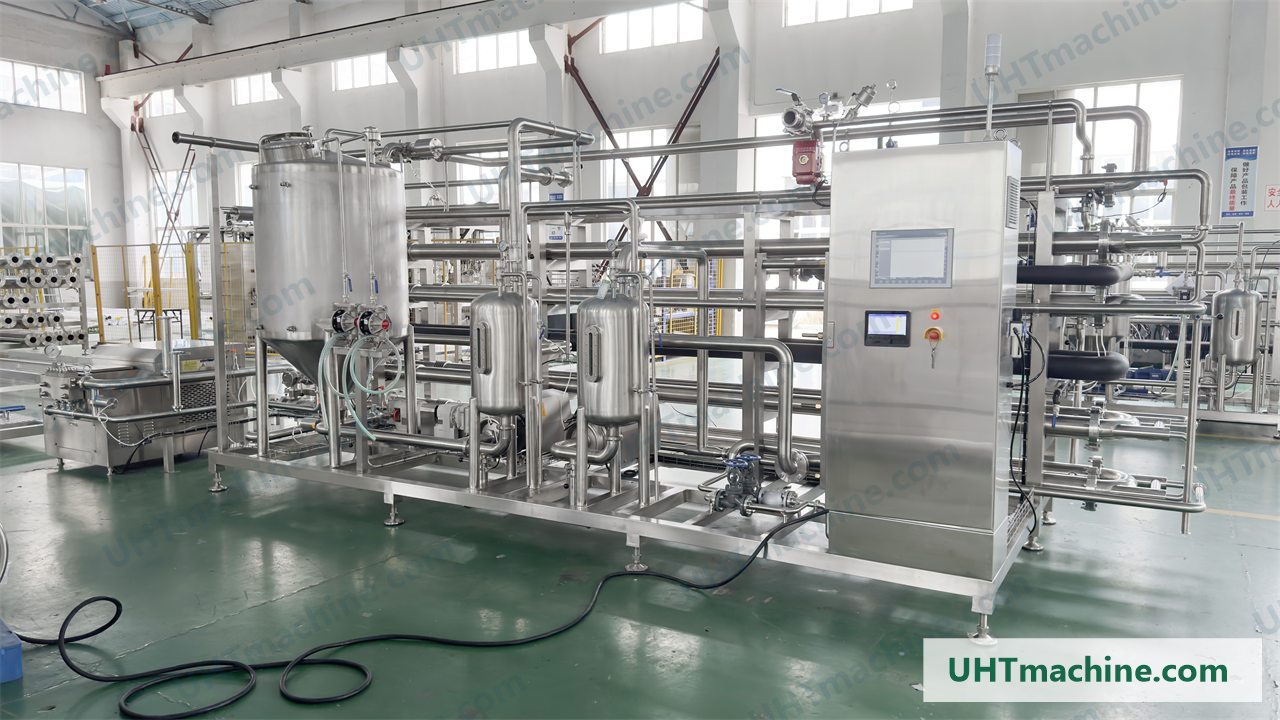
Technical overview
Sauces, puree, syrup, plant-based bases, and other viscous liquid foods may need a larger flow path and stronger transfer design than low-viscosity beverage lines. Product behavior is the first selection factor.
Engineering review should cover viscosity at process temperature, particle size, shear sensitivity, pump selection, heating uniformity, holding design, cooling duty, cleaning time, and likely fouling points.
Tube-in-tube UHT lines may require careful coordination with upstream mixing, deaeration, homogenization if used, buffer tanks, aseptic filling, and CIP return flow so the complete line operates predictably.
Selection boundary
Room-temperature descriptions are not enough. Flow behavior, particle integrity, pumping, heat transfer, and cleaning must be evaluated under the proposed process conditions.
| Geometry definition | Confirm that “tube-in-tube” refers to the quoted concentric arrangement and identify whether product flows in the inner tube or annulus. Record the minimum passage, diameters, heating-medium path, removable sections, and expansion allowances. |
|---|---|
| Rheology and particles | Provide viscosity versus temperature, particle dimensions and concentration, solids content, yield behavior, and whether the product is shear sensitive. |
| Pumping | Confirm pump type, differential pressure, slip or pulsation controls, startup product loss, and the lowest stable production rate. |
| Thermal uniformity | Ask how velocity profile, residence-time distribution, wall temperature, holding section, and cold-spot risk are handled for the quoted product. |
| Fouling and cleaning | Define expected run length, product recovery, CIP flow criteria, difficult-to-clean sections, inspection access, and criteria for a repeat cycle. |
| Line integration | Freeze mixer, deaerator, buffer, filler, valve, transfer-pressure, sterile-boundary, and controls responsibilities before purchase. |
Inquiry checklist
Buyer questions
Choose it for review when the product is more viscous, contains pulp or suspended solids, or needs a larger sanitary flow path than a plate exchanger can provide.
It can be configured for some sauces and purees, but viscosity, particles, heat sensitivity, and fouling risk must be reviewed before quotation.
Viscosity affects pumping, pressure drop, heat transfer, holding accuracy, cleaning difficulty, and whether the selected exchanger can run stably.
Provide formula notes, viscosity at relevant temperatures, particle size and concentration, target shelf life, package and storage conditions, target market, capacity, cleaning constraints, utilities, and who validates the final process.