Formula screening
Compare heat stability, flavor, color, viscosity, separation, particle integrity, and residue under controlled conditions. Define the test question and acceptance measurements before choosing modules or setpoints.
Pilot and R&D guide
Lab and pilot UHT systems help teams compare formulas and process options using controlled small-scale trials before production-scale equipment is selected.
Use pilot results to narrow uncertainty; they do not prove production commercial sterility or packaged shelf life.
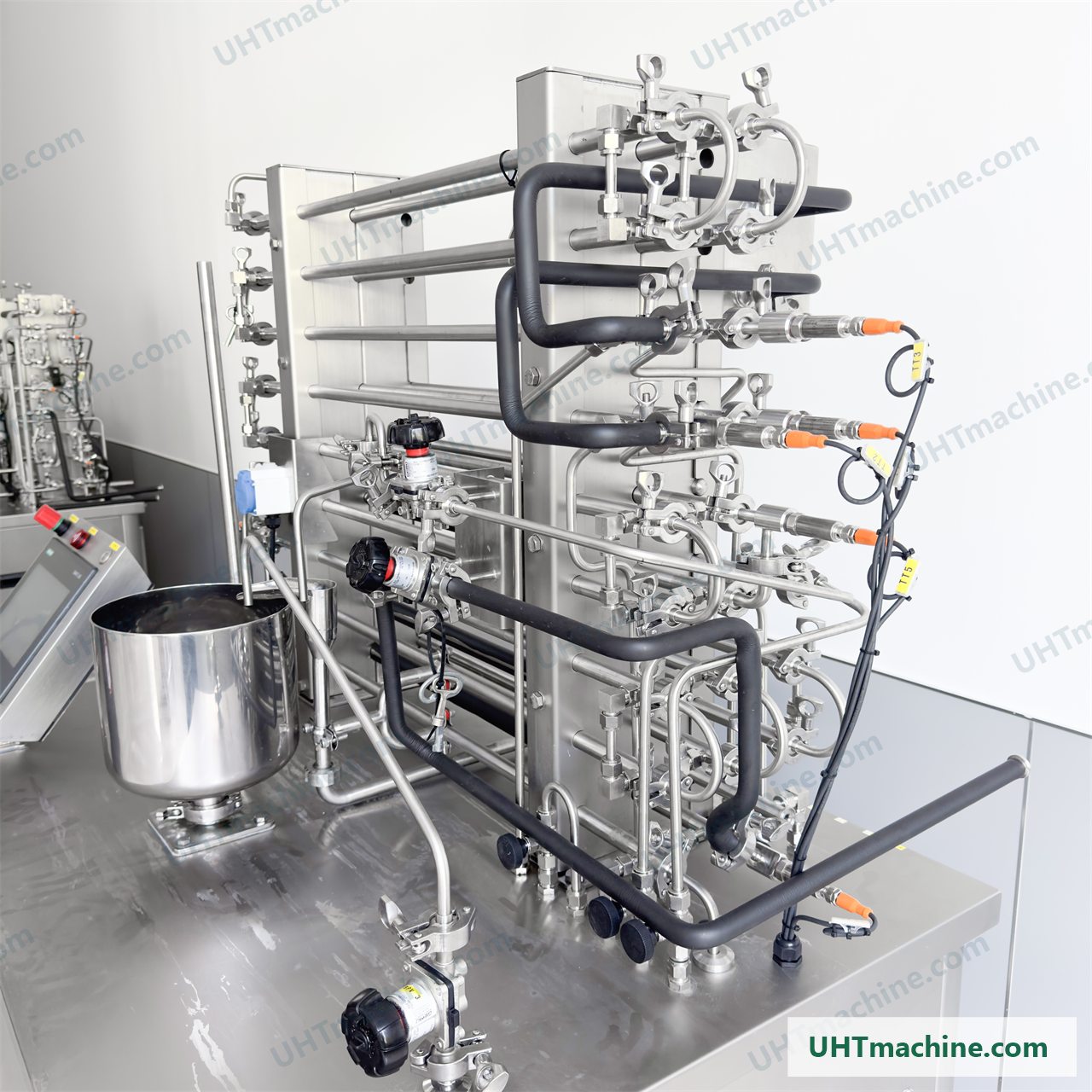
Technical overview
Compare heat stability, flavor, color, viscosity, separation, particle integrity, and residue under controlled conditions. Define the test question and acceptance measurements before choosing modules or setpoints.
Where the verified configuration allows it, compare direct or indirect heating, exchanger geometry, homogenization position, holding sections, cooling, sampling, and cleaning without treating the equipment label as a capability claim.
Translate useful results into production flow, heat-transfer, pressure, residence-time, fouling, cleaning, controls, and package-interface questions. Identify every factor that cannot be transferred directly to full scale.
Trial handling
Small-scale trials still need controlled product identity, feed conditions, sample handling, cleaning, and data records. The image shows a feeding activity, not a validated aseptic sampling result.
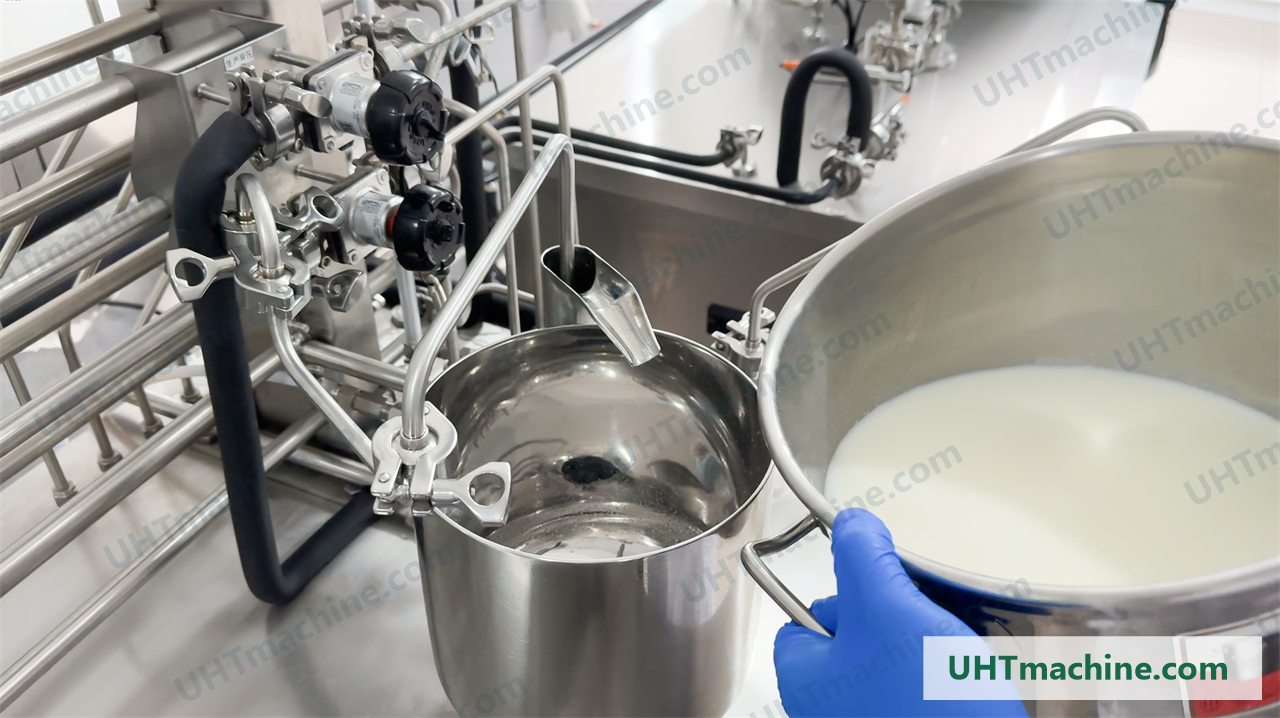
Record batch identity, available feed quantity, feed temperature, stable flow period, samples, losses, cleaning state, alarms, and every intervention that can affect the result.
Pilot evidence
A laboratory result is useful only when the equipment records enough process data and the test can be related to the planned production system.
| Trial envelope | Confirm minimum feed quantity, stable throughput range, verified heating modes, hold-tube options, pressure and cooling limits, product hold-up, and utilities from model-specific evidence. |
|---|---|
| Process records | Require calibrated temperature, flow and pressure data, recipe and alarm history, sample identification, and exportable time-series records. |
| Product observations | Plan measurements for flavor, color, viscosity, separation, particle integrity, fouling, product loss, and cleaning response. |
| Sample boundary | Define how samples are cooled, collected, filled, identified, protected, and tested. Do not describe samples as aseptic unless the complete collection and packaging boundary supports that claim. |
| Scale-up basis | Document which residence time, heat-transfer, shear, pressure and cleaning results can be transferred and which require new production-scale validation. |
Module plan
Optional modules should be listed as installed, available, excluded, or supplied by others. Their presence cannot be inferred from a generic lab or pilot designation.
Set available volume, stable feed, mixing, filtration, deaeration, and inlet condition.
Document installed direct or indirect modules, heat-transfer geometry, culinary-steam or vacuum scope, and control method.
Define upstream or downstream position, verified operating envelope, bypass, and required measurements.
List available holding sections, flow evidence, sensors, cooling capacity, and sample condition.
Synchronize sample identity with calibrated temperature, flow, pressure, recipe, alarm, and time-series records.
Freeze the cleaning sequence, circuit boundary, changeover check, residue assessment, and next-trial release criteria.
Inquiry checklist
Buyer questions
The labels are not standardized. Compare actual feed volume, stable throughput, process modules, data capture, sample handling, utilities, and scale-up objective instead of relying on the name alone.
Trial results can support heating-method, fouling, holding, cleaning, and quality decisions, but production capacity, controls, sterile boundaries, and packaging still require production-scale engineering and validation.
Some configurations can, but the quote must identify the installed heating modules, culinary-steam and vacuum scope, holding options, controls, and changeover procedure.
Not automatically. Sample claims depend on the validated cooling, transfer, collection, filling, packaging, and handling boundary.
Provide product properties, available feed volume, trial objectives, process conditions to investigate, required modules, samples, data outputs, utilities, cleaning needs, and the intended scale-up decision.