Typical product fit
Plate UHT systems may fit milk, flavored dairy beverages, clear juice drinks, tea, coffee, and other low-viscosity formulas. The product should be reviewed for particles, fiber, pulp, or residue that could affect plate channels.
Product type guide
A plate UHT sterilizer is usually considered when the product is low-viscosity, cleanly pumpable, and the buyer wants compact heat exchange with efficient energy recovery.
Confirm that viscosity, particles, fouling, gasket compatibility, and pressure drop remain within the proposed plate heat exchanger limits.
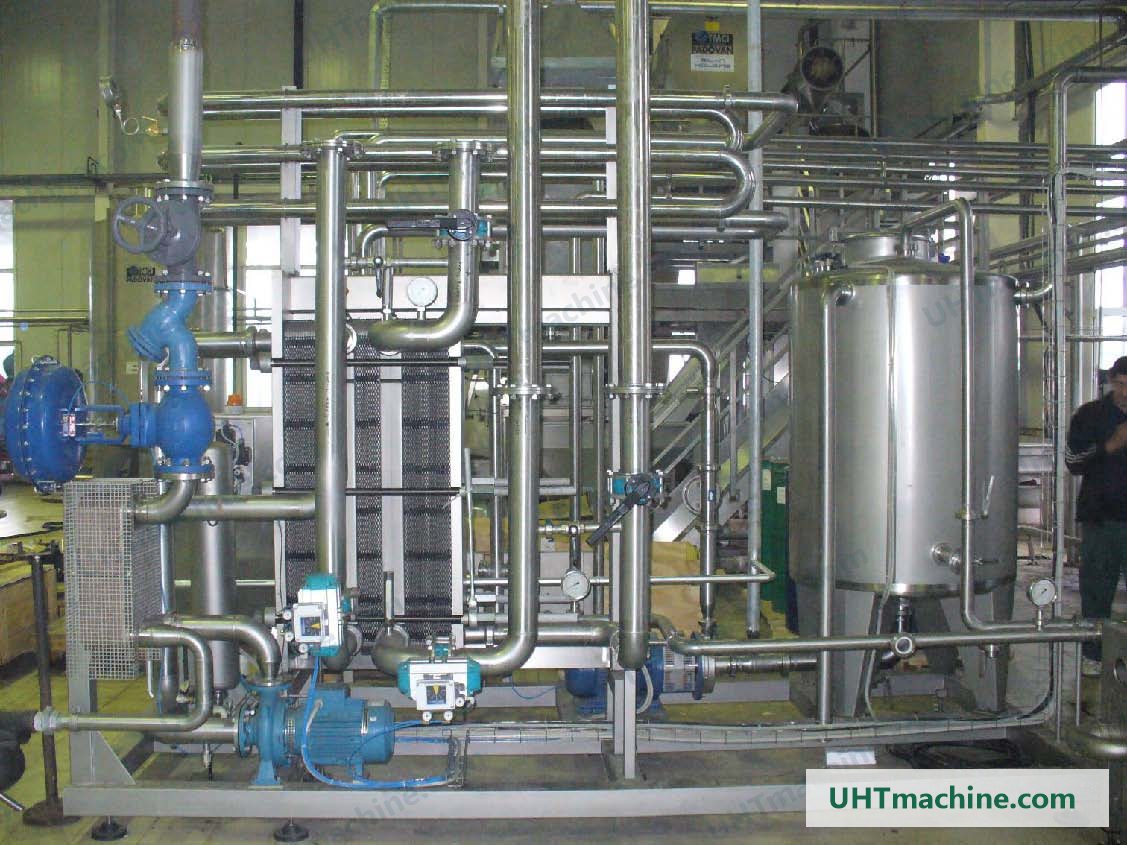
Technical overview
Plate UHT systems may fit milk, flavored dairy beverages, clear juice drinks, tea, coffee, and other low-viscosity formulas. The product should be reviewed for particles, fiber, pulp, or residue that could affect plate channels.
Buyers often evaluate compact footprint, heat-transfer efficiency, energy recovery, cleaning time, maintenance access, and whether the plate design fits the product formula without excessive pressure drop or fouling.
If the product has higher viscosity, pulp, particles, or a strong fouling tendency, tube-in-tube or tubular designs may be safer. The correct decision should be based on product behavior rather than a fixed catalog answer.
Selection boundary
Plate heat exchangers can be compact and efficient, but the proposal must show that channel geometry and pressure drop fit the actual product.
| Product fit | Confirm the product is sufficiently homogeneous and pumpable for the selected channel gap, including pulp, fiber, stabilizer, and precipitation risks. |
|---|---|
| Pressure and shear | Request pressure-drop calculations across the full circuit and confirm the effect on pumps, homogenization, product texture, and filler inlet conditions. |
| Fouling margin | Ask how protein, minerals, sugar, acidity, and product changes affect run length, temperature approach, cleaning frequency, and plate inspection. |
| Maintenance | Define plate material, gasket compatibility, spare strategy, opening and tightening procedure, leak detection, and post-maintenance validation. |
| Alternative trigger | Require a documented reason to move to tubular or tube-in-tube geometry when particles, viscosity, fouling, or cleaning risk exceed the plate design boundary. |
Inquiry checklist
Buyer questions
It is best considered for low-viscosity pumpable liquids where compact heat exchange, energy recovery, and stable continuous processing are important.
It may handle clear or low-pulp juice drinks, but pulp, fiber, and fouling behavior should be reviewed before selecting the heat exchanger format.
Not inherently. A plate system can be compact for suitable products, but compare total cost on the same capacity, materials, energy recovery, automation, CIP, integration, and delivery scope.
Send product type, viscosity, pulp or particle level, target capacity, temperature requirement, filling method, cleaning expectations, and available utilities.